NHTSA // CRASH-TESTED
2024 Hyundai Palisade Safety Ratings
The 2024 Hyundai Palisade scores 77 out of 100 on the NHTSA Safety Index (Average), with a 5-star overall NHTSA crash rating, 5 recalls, and 365 owner complaints on file.
Updated Oct 1, 2026 from NHTSA data · Reviewed by Ivanna Verstliar
The 2024 Hyundai Palisade carries a NHTSA Safety Index of 77/100, positioning it in the Average band. While its NHTSA crash-test scores are strong, the vehicle's overall safety profile is diminished by five recalls, including a park-outside advisory. Additionally, a low sub-score in avoidance technology contributes to the decline from the previous year's evaluation.
The 2024 Hyundai Palisade received a NHTSA Safety Index of 77 out of 100 and an NHTSA overall crash-test rating of 5 out of 5 stars, based on federal NHTSA data.
MotorCaliber Safety Desk // NHTSA data, verified Oct 1, 2026
Among the 144 SUVs from 2024 that NHTSA has crash-tested, the 2024 Hyundai Palisade ranks 130 for overall NHTSA Safety Index.
- urban drivers exposed to side-impact risk
| NHTSA Safety Index | 77 / 100 (Average) |
|---|---|
| Overall crash rating | 5 of 5 stars |
| Frontal / Side / Rollover | 5 / 5 / 4 stars |
| Rollover risk | 14.3% |
| Recalls on file | 5 (includes park-outside) |
| Owner complaints | 365 (unverified allegations) |
| Class rank | 130 of 144 SUVs tested for 2024 |
| Data verified | Oct 1, 2026 |
ANALYSISHow safe is the 2024 Hyundai Palisade?
The 2024 Hyundai Palisade earns an overall Safety Index score of 77 out of 100, placing it in the Average safety band. This marks a three point decline from the 2023 model's 80 out of 100 score. While the crash-protection sub-score is an impressive 66 out of 70, reflecting a 5-star overall NHTSA rating, the vehicle's structural safety elements present significant concerns. Its avoidance technology sub-score of 5 out of 10 is low for its segment and price, directly impacting the overall Safety Index. The defect record further diminishes the score, earning only 6 out of 20 due to five recalls. Notably, a July 2023 recall addressed the transmission pump, requiring owners to park outside, and a February 2024 recall concerned engine valve spring breakage. Both directly affect the 2024 model year. Additional recalls for seat belt buckles and curtain airbags, while broader in scope, contribute to this lower sub-score. The volume of 365 owner complaints, with 217 specifically citing brake issues, warrants attention for a vehicle of this age.
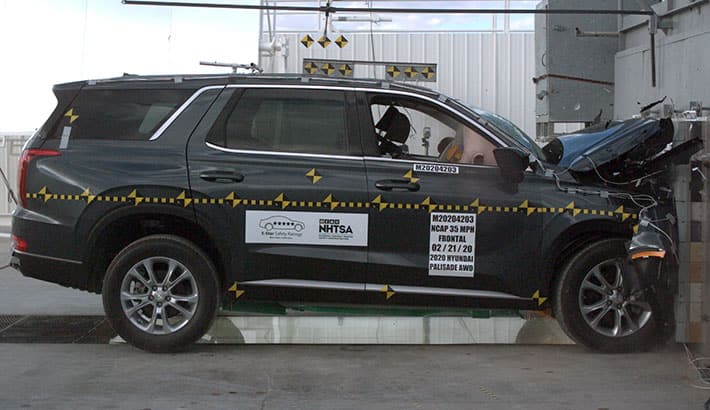
NCAP // CRASH TESTHow did the 2024 Hyundai Palisade perform in crash tests?
The 2024 Hyundai Palisade Early Release AWD achieves an overall 5 out of 5 stars in NHTSA's safety ratings. Its performance in frontal and side crash protection stands out, earning perfect 5-star scores in both categories. The rollover assessment presents a relative vulnerability, receiving 4 out of 5 stars. This is accompanied by a measured rollover risk of 14 percent, although the vehicle did not tip in dynamic testing.
Source: NHTSA NCAP, VehicleId 19553
Index breakdown
NCAP // CRASH IMAGESCrash-test images
Crash-test images are US federal government works (NHTSA / NCAP), public domain.
NHTSA // RECALLSDoes the 2024 Hyundai Palisade have any recalls?
Yes. The 2024 Palisade carries five recall campaigns. Components affected include side and window curtain air bags, rear seat belt buckle assemblies, internal engine hard parts tied to valve spring breakage, a front passenger occupant classification sensor on dark premium suede seat trims, and the automatic transmission fluid pump. That last campaign, covering 2023-2024 Palisade vehicles, carries a park-outside or do-not-drive designation and is the most serious safety action of the five.
AIR BAGS:SIDE/WINDOW:CURTAIN26V034000
Risk: Improper side curtain air bag deployment increases the risk of injury during a crash.
Remedy: Dealers will install a protective film over the rear window and remove padding, as necessary free of charge. Interim notification letters, notifying owners of the safety risk, were mailed beginning March 13, 2026. Final remedy owner letters will be mailed in phases, beginning in June 2026 and expected to continue through December 2026. Owners may contact Hyundai customer service at 1-855-371-9460.
Reported 2026-01-23
SEAT BELTS: REAR/OTHER:BUCKLE ASSEMBLY25V607000
Risk: Seat belt buckles that fail to latch may not properly restrain occupants in a crash, increasing the risk of injury.
Remedy: Passengers are advised to insert the belt firmly into the buckle with a quick and direct motion, pulling on the belt to confirm the seat belt is fully secured, until the recall remedy is performed. Dealers will replace the seat belt buckle assemblies, free of charge. Interim notification letters, notifying owners of the safety risk, were mailed beginning October 23, 2025. Final remedy owner letter
Reported 2025-09-12
ENGINE AND ENGINE COOLING:ENGINE:HARD PARTS INTERNAL/MECHANICAL24V106000
Risk: A loss of drive power increases the risk of a crash. A hole in the engine block increases the risk of a fire.
Remedy: Dealers will replace the engine sub-assembly, free of charge. Owner notification letters were mailed by December 6, 2024. Owners may contact Hyundai customer service at 1-855-371-9460. Hyundai's number for this recall is 255.
Reported 2024-02-13
AIR BAGS:SENSOR:OCCUPANT CLASSIFICATION:FRONT PASSENGER23V599000
Risk: Deactivated front passenger air bags will not deploy as intended, increasing the risk of injury during a crash.
Remedy: Dealers will update the ODS software, free of charge. Owner notification letters were mailed September 26th, 2023. Owners may contact Hyundai customer service at 1-855-371-9460. Hyundai's number for this recall is 249.
Reported 2023-08-25
POWER TRAIN:AUTOMATIC TRANSMISSION:FLUID/LUBRICANT:PUMP23V526000
Risk: An electric oil pump assembly that overheats increases the risk of a vehicle fire.
Remedy: Owners are advised to park outside and away from structures until the recall repair is complete. Dealers will inspect and replace the electric oil pump controller, as necessary, free of charge. Owner notification letters were mailed starting September 7, 2023. Owners may contact Hyundai customer service at 1-855-371-9460. Hyundai's number for this recall is 246.
Reported 2023-07-27
NHTSA // COMPLAINTSWhat do owners report about the 2024 Hyundai Palisade?
NHTSA has received 365 unverified consumer allegations for the 2024 Palisade. Service brakes dominate at 217 reported complaints, followed by alleged issues with forward collision avoidance (52), seat belts (42), and air bags (19). Fifteen alleged crashes and 8 alleged injuries appear in the dataset. All are unverified allegations, not established facts.
365 owner complaints on file. These are unverified allegations reported to NHTSA.
USED BUYERWhat should used buyers know about the 2024 Hyundai Palisade?
Five open recalls mark the 2024 Palisade's safety profile, a significant number for a new model year. Prospective owners must verify the completion of all outstanding campaigns, particularly the urgent park-outside transmission pump recall and the engine valve spring recall. Documentation from the seller confirming these remedies is essential.
- The 2024 Palisade's Safety Index dropped three points to 77/100 versus the 2023 model's 80/100, moving from the Strong band to the Average band, driven largely by a defect-record sub-score of just 6 out of 20.
- A park-outside or do-not-drive recall covering the automatic transmission fluid pump was issued for 2023-2024 Palisade vehicles and is the highest-severity safety action attached to this model year.
- An engine valve spring breakage recall issued in February 2024 applies specifically to 2024 Palisade vehicles, meaning it is not a carryover concern from prior years but a defect identified within this production cycle.
- Reported service brake complaints total 217 of the 365 unverified consumer allegations on file with NHTSA for this model year, making brakes by far the most-cited component in the complaint record.
RANKINGSWhere the 2024 Hyundai Palisade places
The 2024 Hyundai Palisade qualifies for these MotorCaliber safety rankings:
FAQ2024 Hyundai Palisade safety questions
Was the 2024 Hyundai Palisade crash-tested by NHTSA?
Yes. NHTSA crash-tested the 2024 Hyundai Palisade, and it earns a NHTSA Safety Index of 77 out of 100, placing it in the Average band. The index combines federal crash-test stars, standard crash-avoidance tech, and the recall record.
What are the 2024 Hyundai Palisade crash-test star ratings?
In NHTSA testing the 2024 Hyundai Palisade earned 5 out of 5 stars for overall, 5 out of 5 stars for frontal, 5 out of 5 stars for side, and 4 out of 5 stars for rollover. Its measured rollover risk is 14.3%. Categories NHTSA did not test show as not rated.
How many recalls does the 2024 Hyundai Palisade have?
According to NHTSA recall data, 5 vehicle recalls are on file for the 2024 Hyundai Palisade, including a park-outside or do-not-drive campaign, which is the most serious class of recall. Confirm your VIN at nhtsa.gov to see which apply to your car.
How many complaints have owners filed about the 2024 Hyundai Palisade?
According to NHTSA's complaint database, 365 owner complaints are on file for the 2024 Hyundai Palisade. These are unverified allegations submitted by owners, not confirmed defects, and include reports involving a crash or a fire.
Cross-check this record against independent expert reviews and the live NHTSA database before you buy.
Other Palisade years
Rivals in SUV (2024)
| Vehicle | NHTSA Safety Index | Overall stars | Recalls |
|---|---|---|---|
| 2024 Lexus Rz 300e | 100/100 | not rated | 0 |
| 2024 Tesla Model Y Rwd | 100/100 | 5 of 5 | 0 |
| 2024 Subaru Forester Wilderness | 98/100 | not rated | 0 |
| 2024 Lexus Rz 450e | 96/100 | 5 of 5 | 0 |
| 2024 Buick Encore GX | 95/100 | 5 of 5 | 2 |
| 2024 Nissan Murano | 95/100 | 5 of 5 | 1 |
- DATA Pulled directly from NHTSA: New Car Assessment Program crash tests (VehicleId 19553), the recallsByVehicle and complaintsByVehicle records for the Hyundai Palisade 2024.
- SCORE The NHTSA Safety Index (0-100) weights crash protection, standard crash-avoidance tech, and the defect record. Full formula on the methodology page. It ranks 130 of 144 in the SUV class for 2024.
- EDITED Written by the MotorCaliber Safety Desk and reviewed for accuracy and plain-language clarity by Ivanna Verstliar, Editor, against the source figures on this page.
- VERIFIED Data last synced Oct 1, 2026. Recalls change; confirm your VIN at nhtsa.gov/recalls. See our corrections policy and disclosure.