NHTSA // CRASH-TESTED
2022 Mazda CX-30 Safety Ratings
The 2022 Mazda CX-30 scores 92 out of 100 on the NHTSA Safety Index (Exceptional), with a 5-star overall NHTSA crash rating, 1 recall, and 31 owner complaints on file.
Updated Oct 1, 2026 from NHTSA data · Reviewed by Ivanna Verstliar
The 2022 Mazda CX-30 achieves an exceptional NHTSA Safety Index of 92 out of 100. This strong score is grounded in robust NHTSA crash-test performance and a comprehensive array of standard crash-avoidance technology. Its record of a single recall further reinforces its standing, presenting a well-supported option based on these safety metrics.
The 2022 Mazda CX-30 received an overall 5-star crash-test rating from NHTSA and holds a NHTSA Safety Index of 92/100, sourced from NHTSA crash-test and recall data.
MotorCaliber Safety Desk // NHTSA data, verified Oct 1, 2026
Among the 135 SUVs from 2022 that NHTSA has crash-tested, the 2022 Mazda CX-30 ranks 20 for overall NHTSA Safety Index.
- new and teen drivers who want standard crash-avoidance tech
- urban drivers exposed to side-impact risk
| NHTSA Safety Index | 92 / 100 (Exceptional) |
|---|---|
| Overall crash rating | 5 of 5 stars |
| Frontal / Side / Rollover | 5 / 5 / 4 stars |
| Rollover risk | 14.7% |
| Recalls on file | 1 |
| Owner complaints | 31 (unverified allegations) |
| Class rank | 20 of 135 SUVs tested for 2022 |
| Data verified | Oct 1, 2026 |
ANALYSISHow safe is the 2022 Mazda CX-30?
The 2022 model year marks a meaningful step forward for the CX-30 in MotorCaliber's scoring. The Safety Index climbed from 88/100 in 2021, which sat in the Strong band, to 92/100 in 2022, crossing into the Exceptional band. That four-point gain is not cosmetic. The crash-protection sub-score of 66 out of 70 points anchors the index, supported by a perfect 10 out of 10 for crash-avoidance technology, reflecting the standard fitment of forward collision warning, lane departure warning, and electronic stability control across the lineup. The defect record sub-score of 16.25 out of 20 reflects the single ABS module recall, which is a narrow footprint compared to multi-campaign years. The rollover score of 4 out of 5 stars is the one area where the vehicle does not achieve a top mark, and buyers should note the 15 percent rollover risk figure in that context. Taken together, 2022 is the year this generation of the CX-30 most clearly separates itself from its immediate predecessor on federal safety metrics.
NCAP // CRASH TESTHow did the 2022 Mazda CX-30 perform in crash tests?
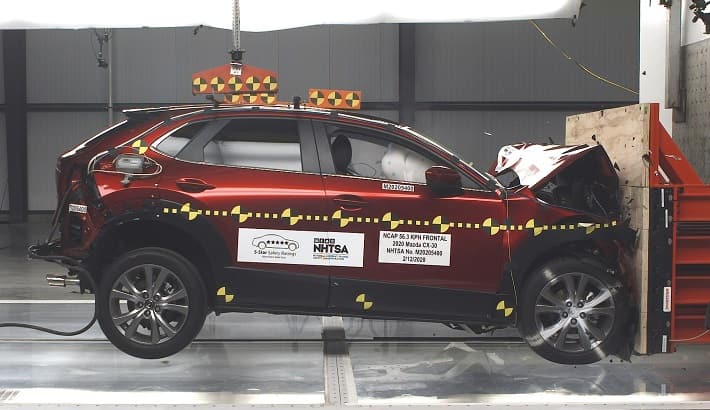
The 2022 Mazda CX-30 AWD achieved 5 out of 5 stars for overall crash protection from NHTSA. Both frontal and side impact tests yielded perfect 5-star ratings. The CX-30 AWD earned 4 out of 5 stars in the rollover assessment, with a 15 percent risk of rollover and a "No Tip" result in the dynamic test.
Source: NHTSA NCAP, VehicleId 16099
Index breakdown
NCAP // CRASH IMAGESCrash-test images
Crash-test images are US federal government works (NHTSA / NCAP), public domain.
NHTSA // RECALLSDoes the 2022 Mazda CX-30 have any recalls?
The 2022 Mazda CX-30 carries one recall campaign. It targets the anti-lock brake system control module, covering certain 2022-2023 CX-30 vehicles. A compromised ABS module can affect brake performance in critical situations. No park-outside or do-not-drive directive is noted in the data, but used-market buyers should verify remedy completion by VIN through NHTSA.
SERVICE BRAKES, HYDRAULIC:ANTILOCK/TRACTION CONTROL/ELECTRONIC LIMITED SLIP:CONTROL UNIT/MODULE23V275000
Risk: Reduced braking ability can increase the distance required to stop the vehicle, increasing the risk of a crash.
Remedy: Dealers will inspect and replace the ABS HCU, as necessary, free of charge. Owner notification letters were mailed June 12, 2023. Owners may contact Mazda customer service at 1-800-222-5500 Option 6. Mazda's number for this recall is 5823D.
Reported 2023-04-18
NHTSA // COMPLAINTSWhat do owners report about the 2022 Mazda CX-30?
Owners have filed 31 unverified complaints with NHTSA, including alleged reports of 4 crashes and 3 injuries. The most frequently alleged problem areas are Engine (9 reports), Steering (6), Electrical System (6), Forward Collision Avoidance (5), and Air Bags (3). These are unverified consumer allegations, not established defects.
31 owner complaints on file. These are unverified allegations reported to NHTSA.
USED BUYERWhat should used buyers know about the 2022 Mazda CX-30?
The 2022 Mazda CX-30 was subject to a recall concerning its ABS module. Any owner or prospective buyer should verify this recall's completion status through NHTSA's database or directly with a Mazda dealership.
- The 2022 Safety Index of 92/100 represents a four-point increase over the 2021 model year's 88/100, moving the CX-30 from the Strong band into the Exceptional band for the first time.
- A single recall covering the ABS hydraulic control module was issued for certain 2022-2023 CX-30 vehicles. Used-market buyers must verify by VIN whether this brake-system remedy has been completed.
- NHTSA logged 31 unverified owner complaints for this model year, with Engine, Steering, and Forward Collision Avoidance among the most frequently alleged problem areas. These are consumer-reported allegations only.
- Rollover protection scores 4 out of 5 stars with a 15 percent rollover risk and a No Tip result on the dynamic test, making it the one sub-category where the 2022 CX-30 does not achieve the top federal rating.
RANKINGSWhere the 2022 Mazda CX-30 places
The 2022 Mazda CX-30 qualifies for these MotorCaliber safety rankings:
FAQ2022 Mazda CX-30 safety questions
Was the 2022 Mazda CX-30 crash-tested by NHTSA?
Yes. NHTSA crash-tested the 2022 Mazda CX-30, and it earns a NHTSA Safety Index of 92 out of 100, placing it in the Exceptional band. The index combines federal crash-test stars, standard crash-avoidance tech, and the recall record.
What are the 2022 Mazda CX-30 crash-test star ratings?
In NHTSA testing the 2022 Mazda CX-30 earned 5 out of 5 stars for overall, 5 out of 5 stars for frontal, 5 out of 5 stars for side, and 4 out of 5 stars for rollover. Its measured rollover risk is 14.7%. Categories NHTSA did not test show as not rated.
How many recalls does the 2022 Mazda CX-30 have?
According to NHTSA recall data, 1 vehicle recall is on file for the 2022 Mazda CX-30. Confirm your VIN at nhtsa.gov to see which apply to your car.
How many complaints have owners filed about the 2022 Mazda CX-30?
According to NHTSA's complaint database, 31 owner complaints are on file for the 2022 Mazda CX-30. These are unverified allegations submitted by owners, not confirmed defects, and include reports involving a crash.
Cross-check this record against independent expert reviews and the live NHTSA database before you buy.
Other CX-30 years
Rivals in SUV (2022)
| Vehicle | NHTSA Safety Index | Overall stars | Recalls |
|---|---|---|---|
| 2022 Tesla Model Y 5-Seat | 100/100 | 5 of 5 | 0 |
| 2022 Infiniti Qx55 | 99/100 | not rated | 1 |
| 2022 Buick Encore GX | 95/100 | 5 of 5 | 1 |
| 2022 Buick Envision | 95/100 | 5 of 5 | 1 |
| 2022 Nissan Murano | 95/100 | 5 of 5 | 0 |
| 2022 Buick Enclave | 94/100 | 4 of 5 | 1 |
- DATA Pulled directly from NHTSA: New Car Assessment Program crash tests (VehicleId 16099), the recallsByVehicle and complaintsByVehicle records for the Mazda CX-30 2022.
- SCORE The NHTSA Safety Index (0-100) weights crash protection, standard crash-avoidance tech, and the defect record. Full formula on the methodology page. It ranks 20 of 135 in the SUV class for 2022.
- EDITED Written by the MotorCaliber Safety Desk and reviewed for accuracy and plain-language clarity by Ivanna Verstliar, Editor, against the source figures on this page.
- VERIFIED Data last synced Oct 1, 2026. Recalls change; confirm your VIN at nhtsa.gov/recalls. See our corrections policy and disclosure.