NHTSA // CRASH-TESTED
2020 Chevrolet Bolt EV Safety Ratings
The 2020 Chevrolet Bolt EV scores 71 out of 100 on the NHTSA Safety Index (Average), with a 5-star overall NHTSA crash rating, 8 recalls, and 170 owner complaints on file.
Updated Oct 1, 2026 from NHTSA data · Reviewed by Ivanna Verstliar
The most significant safety concern for the 2020 Chevrolet Bolt EV continues to be its defect record, which earned a score of 0 out of 20 in our analysis. Multiple active battery fire recalls, including directives for owners to park outside, pose a serious and ongoing safety concern. Despite these issues, the vehicle demonstrates strong crash-test performance. Overall, the 2020 Bolt EV earns a NHTSA Safety Index of 71 out of 100, placing it in the Average band.
The 2020 Chevrolet Bolt EV holds a NHTSA Safety Index of 71/100 and an NHTSA overall crash-test rating of 5 out of 5 stars, sourced from NHTSA federal safety data.
MotorCaliber Safety Desk // NHTSA data, verified Oct 1, 2026
Among the 105 Sedans from 2020 that NHTSA has crash-tested, the 2020 Chevrolet Bolt EV ranks 98 for overall NHTSA Safety Index.
- families prioritizing rollover safety
- urban drivers exposed to side-impact risk
| NHTSA Safety Index | 71 / 100 (Average) |
|---|---|
| Overall crash rating | 5 of 5 stars |
| Frontal / Side / Rollover | 4 / 5 / 5 stars |
| Rollover risk | 9.7% |
| Recalls on file | 8 (includes park-outside) |
| Owner complaints | 170 (unverified allegations) |
| Class rank | 98 of 105 Sedans tested for 2020 |
| Data verified | Oct 1, 2026 |
ANALYSISHow safe is the 2020 Chevrolet Bolt EV?
The 2020 Chevrolet Bolt EV's safety profile is defined by an unprecedented defect record, scoring 0 out of 20 points. This reflects the impact of an escalating recall history concerning the traction battery. A 2021 recall instructing owners to park outside was followed by a 2024 reissuance when the initial remedy proved insufficient, and then by a second reissuance in the same year. This pattern of repeated, inadequate corrective actions for a single component defines the model year's safety narrative. Despite this, the vehicle's crash protection score of 65 out of 70 is genuinely strong. Its dynamic no-tip result in rollover testing further reinforces structural competence. The avoidance technology score of 6 out of 10 stems from forward collision warning and lane departure warning being optional. This means some 2020 units on the used market may lack these features, depending on their original configuration. Overall, the 2020 Chevrolet Bolt EV earns a Safety Index of 71 out of 100, placing it in the Average band. This represents a two-point decline from the 2019 model's 73 out of 100, a drop almost entirely attributable to its defect record.
NCAP // CRASH TESTHow did the 2020 Chevrolet Bolt EV perform in crash tests?
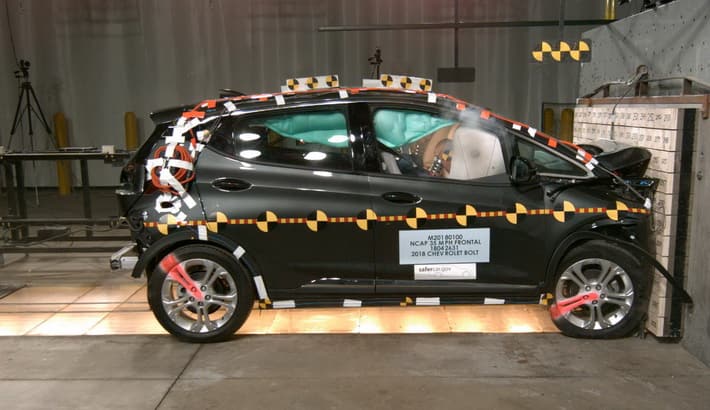
For the 2020 model year, the Chevrolet Bolt EV's crash-test performance stands out for its consistent high scores. The vehicle achieved an overall 5-out-of-5-star rating from NHTSA. Both side-impact protection and rollover protection were rated 5 stars, with the latter showing a 10 percent rollover risk and a "no-tip" dynamic test result. The sole deviation from a perfect score appeared in the frontal crash category, which received 4 out of 5 stars.
Source: NHTSA NCAP, VehicleId 14316
Index breakdown
NCAP // CRASH IMAGESCrash-test images
Crash-test images are US federal government works (NHTSA / NCAP), public domain.
NHTSA // RECALLSDoes the 2020 Chevrolet Bolt EV have any recalls?
Yes. The 2020 Bolt EV carries 8 recall campaigns. Three are park-outside or do-not-drive orders tied to the high-voltage traction battery, which could ignite a fire. Additional campaigns address roof and pillar structure after crashes involving seat belt pretensioner deployment. The battery recalls have been reissued multiple times after prior remedies proved insufficient.
ELECTRICAL SYSTEM:PROPULSION SYSTEM:TRACTION BATTERY24V812000
Risk: A battery fire increases the risk of injury.
Remedy: Owners are advised to take the following interim steps: Set the Target Charge Level feature in their vehicle to limit the charge level to 90%, charge their vehicle more frequently, avoid depleting the battery to 70 miles range remaining, park outside after charging, and do not charge the vehicle indoors overnight. Dealers will reinstall advanced diagnostic software, free of charge. Owner notificat
Reported 2024-10-31
ELECTRICAL SYSTEM:PROPULSION SYSTEM:TRACTION BATTERY24V481000
Risk: A battery fire increases the risk of injury.
Remedy: Owners are advised to take the following interim steps: Set the Target Charge Level feature in their vehicle to limit the charge level to 90%, charge their vehicle more frequently, avoid depleting the battery to 70 miles range remaining, park outside after charging, and do not charge the vehicle indoors overnight. Dealers will reinstall the advanced diagnostic software, free of charge. Owner notif
Reported 2024-06-27
STRUCTURE:BODY:ROOF AND PILLARS23V845000
Risk: A fire increases the risk of injury.
Remedy: Dealers will inspect both front seat belt pretensioners and, if necessary, install metal foil at the carpet near the pretensioner exhaust. Certain vehicles will also need a pretensioner cover installed. Repairs will be performed free of charge. Owner notification letters were mailed January 24, 2024. These vehicles were previously recalled for this same issue under recall number 22V-930 and will n
Reported 2023-12-14
STRUCTURE:BODY:ROOF AND PILLARS22V930000
Risk: A vehicle fire can increase the risk of injury.
Remedy: Dealers will install metal foil at the carpet near the pretensioner exhaust, and install a pretensioner cover as necessary, free of charge. Owner notification letters were mailed between January 23, 2023 and April 25, 2023. Owners may contact Chevrolet customer service at 1-800-222-1020. GM's number for this recall is N222383790.
Reported 2022-12-15
ELECTRICAL SYSTEM:PROPULSION SYSTEM:TRACTION BATTERY21V650000
Risk: A battery fire increases the risk of injury.
Remedy: Owners are advised to take the following interim steps: Set the Target Charge Level feature in their vehicle to limit the charge level to 90%, charge their vehicle more frequently, avoid depleting the battery to 70 miles range remaining, park outside after charging, and do not charge the vehicle indoors overnight. Defective battery modules will be replaced by GM, free of charge. Owner notification
Reported 2021-08-20
SEAT BELTS20V811000
Risk: If a seat belt assembly is not properly attached to the vehicle, the seat belt may not properly restrain an occupant in the event of a crash, increasing the risk of injury.
Remedy: GM will notify owners, and dealers will replace the suspect bolts, free of charge. The recall began January 29, 2021. Owners may contact GMC customer service at 1-800-462-8785, Cadillac customer service at 1-800-458-8006, or Chevrolet customer service at 1-800-222-1020. GM's number for this recall is N202322230.
Reported 2020-12-23
SERVICE BRAKES, HYDRAULIC:FOUNDATION COMPONENTS:DISC:CALIPER20V808000
Risk: If a brake caliper fractures and brake fluid is lost, the vehicle may experience reduced brake performance, increasing the risk of a crash.
Remedy: GM will notify owners, and dealers will inspect the casting lot number on the front left brake caliper and replace it if necessary, free of charge. The recall began January 29, 2021. Owners may contact Chevrolet customer service at 1-800-222-1020. GM's number for this recall is N202321400.
Reported 2020-12-22
LATCHES/LOCKS/LINKAGES:DOORS:LATCH20V184000
Risk: If the rear door opens while driving, or the door handle fails to open the rear door, there is an increased risk of injury to the rear passengers.
Remedy: GM will notify owners, and dealers will replace the rear inside door-handle cables, free of charge. The recall began April 17, 2020. Owners may contact Chevrolet customer service at 1-800-222-1020. GM's number for this recall is A202298320.
Reported 2020-03-26
NHTSA // COMPLAINTSWhat do owners report about the 2020 Chevrolet Bolt EV?
Owners have filed 170 unverified complaints with NHTSA, including alleged reports of 7 crashes and 4 fires. The Electrical System leads all categories with 93 alleged reports, followed by the Fuel and Propulsion System at 29 and Steering at 21. All figures are unverified consumer allegations, not established facts.
170 owner complaints on file. These are unverified allegations reported to NHTSA.
USED BUYERWhat should used buyers know about the 2020 Chevrolet Bolt EV?
A 2020 Bolt EV carries a significant caveat in its recall history. Shoppers considering this model year should prioritize checking the VIN against NHTSA's recall database. The traction battery park-outside campaigns have seen multiple reissues. Verifying the completion of the most recent remedy on any specific vehicle is essential prior to purchase.
- The 2020 Bolt EV's defect record component scores 0 out of 20, the lowest possible, driven by a traction battery recall that was reissued in both June and October 2024 after earlier remedies were deemed insufficient.
- Three of the eight recall campaigns for this model year carry explicit park-outside or do-not-drive designations, meaning owners were directed not to charge indoors or park near structures due to fire risk.
- NHTSA's crash tests gave this model year a 4-star frontal rating against 5-star results in side and rollover categories, making the frontal discipline the one area where crash protection falls short of a perfect score.
- Forward collision warning and lane departure warning were optional equipment on 2020 Bolt EV units, so used-market examples may lack these systems depending on how the original vehicle was configured.
RANKINGSWhere the 2020 Chevrolet Bolt EV places
The 2020 Chevrolet Bolt EV qualifies for these MotorCaliber safety rankings:
FAQ2020 Chevrolet Bolt EV safety questions
Was the 2020 Chevrolet Bolt EV crash-tested by NHTSA?
Yes. NHTSA crash-tested the 2020 Chevrolet Bolt EV, and it earns a NHTSA Safety Index of 71 out of 100, placing it in the Average band. The index combines federal crash-test stars, standard crash-avoidance tech, and the recall record.
What are the 2020 Chevrolet Bolt EV crash-test star ratings?
In NHTSA testing the 2020 Chevrolet Bolt EV earned 5 out of 5 stars for overall, 4 out of 5 stars for frontal, 5 out of 5 stars for side, and 5 out of 5 stars for rollover. Its measured rollover risk is 9.7%. Categories NHTSA did not test show as not rated.
How many recalls does the 2020 Chevrolet Bolt EV have?
According to NHTSA recall data, 8 vehicle recalls are on file for the 2020 Chevrolet Bolt EV, including a park-outside or do-not-drive campaign, which is the most serious class of recall. Confirm your VIN at nhtsa.gov to see which apply to your car.
How many complaints have owners filed about the 2020 Chevrolet Bolt EV?
According to NHTSA's complaint database, 170 owner complaints are on file for the 2020 Chevrolet Bolt EV. These are unverified allegations submitted by owners, not confirmed defects, and include reports involving a crash or a fire.
Cross-check this record against independent expert reviews and the live NHTSA database before you buy.
Other Bolt EV years
Rivals in Sedan (2020)
| Vehicle | NHTSA Safety Index | Overall stars | Recalls |
|---|---|---|---|
| 2020 Acura RLX | 99/100 | 5 of 5 | 1 |
| 2020 Acura RLX Sport | 99/100 | not rated | 1 |
| 2020 Audi S5 Sportback | 99/100 | not rated | 0 |
| 2020 Infiniti Q50 | 99/100 | not rated | 0 |
| 2020 Mazda Mazda3 | 98/100 | 5 of 5 | 2 |
| 2020 Nissan Maxima | 98/100 | 5 of 5 | 1 |
- DATA Pulled directly from NHTSA: New Car Assessment Program crash tests (VehicleId 14316), the recallsByVehicle and complaintsByVehicle records for the Chevrolet Bolt EV 2020.
- SCORE The NHTSA Safety Index (0-100) weights crash protection, standard crash-avoidance tech, and the defect record. Full formula on the methodology page. It ranks 98 of 105 in the Sedan class for 2020.
- EDITED Written by the MotorCaliber Safety Desk and reviewed for accuracy and plain-language clarity by Ivanna Verstliar, Editor, against the source figures on this page.
- VERIFIED Data last synced Oct 1, 2026. Recalls change; confirm your VIN at nhtsa.gov/recalls. See our corrections policy and disclosure.