NHTSA // CRASH-TESTED
2020 Hyundai Venue Safety Ratings
The 2020 Hyundai Venue scores 87 out of 100 on the NHTSA Safety Index (Strong), with a 4-star overall NHTSA crash rating, 1 recall, and 41 owner complaints on file.
Updated Oct 1, 2026 from NHTSA data · Reviewed by Ivanna Verstliar
The 2020 Hyundai Venue earns a NHTSA Safety Index of 87/100, placing it in the Strong band. A 4-star overall NHTSA rating, a perfect avoidance-tech score, and a single recall on record make this a well-supported safety profile for a subcompact entry.
The 2020 Hyundai Venue holds a NHTSA Safety Index of 87/100 and a 5-star NHTSA side-crash rating, according to federal NHTSA data.
MotorCaliber Safety Desk // NHTSA data, verified Oct 1, 2026
Among the 105 Sedans from 2020 that NHTSA has crash-tested, the 2020 Hyundai Venue ranks 56 for overall NHTSA Safety Index.
- new and teen drivers who want standard crash-avoidance tech
- urban drivers exposed to side-impact risk
| NHTSA Safety Index | 87 / 100 (Strong) |
|---|---|
| Overall crash rating | 4 of 5 stars |
| Frontal / Side / Rollover | 4 / 5 / 4 stars |
| Rollover risk | 14.3% |
| Recalls on file | 1 |
| Owner complaints | 41 (unverified allegations) |
| Class rank | 56 of 105 Sedans tested for 2020 |
| Data verified | Oct 1, 2026 |
ANALYSISHow safe is the 2020 Hyundai Venue?
A single open recall for the front seat belts marks the most critical safety item for the 2020 Hyundai Venue. This issue, impacting front restraints that may fail in a crash, extends across model years 2020 to 2022. Prospective owners or those continuing to use a 2020 Venue should verify the recall remedy status by VIN. Despite this, the 2020 Venue achieves a strong NHTSA Safety Index of 87 out of 100 in its debut year, particularly bolstered by its crash-protection subscore of 61 out of 70 and a perfect 10 out of 10 for avoidance technology. This top avoidance score reflects the standard inclusion of forward collision warning, lane departure warning, and electronic stability control. The defect-record subscore stands at 15.5 out of 20, influenced by the aforementioned seat-belt recall. Crash-test results from NHTSA show a 5 out of 5-star rating for side impact protection. Frontal crash tests and rollover assessments both received 4 out of 5 stars. The rollover risk is calculated at 14 percent, complemented by a "No Tip" dynamic test result. The 2020 Venue's first-year safety performance is genuinely strong, founded on its comprehensive avoidance technology and the detailed crash-test data, with the seat-belt recall as the primary safety concern.
NCAP // CRASH TESTHow did the 2020 Hyundai Venue perform in crash tests?
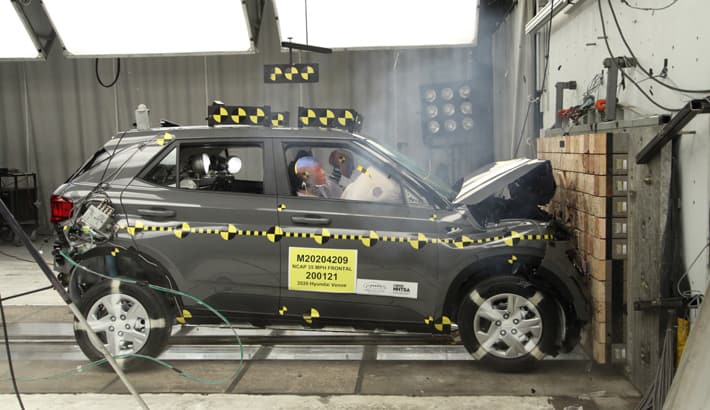
The 2020 Venue achieved a perfect 5-star rating for side-impact protection, a strong performance reinforced by a "No Tip" result in dynamic rollover testing. Overall, the vehicle received 4 out of 5 stars from NHTSA. Frontal crash protection also rated 4 stars, while rollover risk was assessed at 14 percent.
Source: NHTSA NCAP, VehicleId 14410
Index breakdown
NCAP // CRASH IMAGESCrash-test images
Crash-test images are US federal government works (NHTSA / NCAP), public domain.
NHTSA // RECALLSDoes the 2020 Hyundai Venue have any recalls?
One recall campaign covers the 2020 Venue. It targets front seat belts, specifically the driver-side and passenger-side front restraints, on 2020-2022 Venue vehicles. The concern is that in a crash those belts may not perform as intended. No park-outside or do-not-drive directive is noted in the data on file.
SEAT BELTS:FRONT22V458000
Risk: An exploding seat belt pretensioner can project metal fragments into the vehicle, strike vehicle occupants, and result in injury.
Remedy: Dealers will secure the seat belt pretensioners with a cap, free of charge. Owner notification letters were mailed October 25, 2022. Owners may contact Hyundai customer service at 1-855-371-9460. Hyundai's number for this recall is 231. This recall expands and replaces NHTSA recall number 21V-796 for Venue vehicles. Venue vehicles previously repaired under 21V-796 will need to have the new remedy
Reported 2022-06-27
NHTSA // COMPLAINTSWhat do owners report about the 2020 Hyundai Venue?
Forty-one unverified owner complaints have been reported to NHTSA. The most frequently alleged problem areas are Unknown or Other issues (13 reports), seat belts (8), and powertrain (7). Electrical system and forward collision avoidance each appear in the top components. These are unverified consumer allegations, not confirmed defects.
41 owner complaints on file. These are unverified allegations reported to NHTSA.
USED BUYERWhat should used buyers know about the 2020 Hyundai Venue?
Shoppers considering this 6-year-old Venue should run the VIN through NHTSA's recall lookup tool to confirm whether the front seat-belt recall has been remedied. An unresolved restraint recall on a used vehicle is a concrete safety item, not a negotiating point, and should be addressed before driving.
- The 2020 Venue's single recall targets front seat belts on both driver and passenger sides, a direct occupant-restraint concern that must be verified as remedied by VIN before purchase.
- NHTSA awarded the 2020 Venue a 5-star side-crash rating, the strongest individual result in its crash-test profile, while overall, frontal, and rollover ratings each came in at 4 stars.
- The avoidance-tech subscore of 10 out of 10 reflects that forward collision warning, lane departure warning, and electronic stability control were all standard equipment on the 2020 model year, not optional add-ons.
- Eight of the 41 unverified NHTSA complaints specifically allege seat-belt problems, a pattern that aligns directly with the active recall campaign and reinforces the urgency of checking remedy status.
RANKINGSWhere the 2020 Hyundai Venue places
The 2020 Hyundai Venue qualifies for these MotorCaliber safety rankings:
FAQ2020 Hyundai Venue safety questions
Was the 2020 Hyundai Venue crash-tested by NHTSA?
Yes. NHTSA crash-tested the 2020 Hyundai Venue, and it earns a NHTSA Safety Index of 87 out of 100, placing it in the Strong band. The index combines federal crash-test stars, standard crash-avoidance tech, and the recall record.
What are the 2020 Hyundai Venue crash-test star ratings?
In NHTSA testing the 2020 Hyundai Venue earned 4 out of 5 stars for overall, 4 out of 5 stars for frontal, 5 out of 5 stars for side, and 4 out of 5 stars for rollover. Its measured rollover risk is 14.3%. Categories NHTSA did not test show as not rated.
How many recalls does the 2020 Hyundai Venue have?
According to NHTSA recall data, 1 vehicle recall is on file for the 2020 Hyundai Venue. Confirm your VIN at nhtsa.gov to see which apply to your car.
How many complaints have owners filed about the 2020 Hyundai Venue?
According to NHTSA's complaint database, 41 owner complaints are on file for the 2020 Hyundai Venue. These are unverified allegations submitted by owners, not confirmed defects, and include reports involving a crash or a fire.
Cross-check this record against independent expert reviews and the live NHTSA database before you buy.
Other Venue years
Rivals in Sedan (2020)
| Vehicle | NHTSA Safety Index | Overall stars | Recalls |
|---|---|---|---|
| 2020 Acura RLX | 99/100 | 5 of 5 | 1 |
| 2020 Acura RLX Sport | 99/100 | not rated | 1 |
| 2020 Audi S5 Sportback | 99/100 | not rated | 0 |
| 2020 Infiniti Q50 | 99/100 | not rated | 0 |
| 2020 Mazda Mazda3 | 98/100 | 5 of 5 | 2 |
| 2020 Nissan Maxima | 98/100 | 5 of 5 | 1 |
- DATA Pulled directly from NHTSA: New Car Assessment Program crash tests (VehicleId 14410), the recallsByVehicle and complaintsByVehicle records for the Hyundai Venue 2020.
- SCORE The NHTSA Safety Index (0-100) weights crash protection, standard crash-avoidance tech, and the defect record. Full formula on the methodology page. It ranks 56 of 105 in the Sedan class for 2020.
- EDITED Written by the MotorCaliber Safety Desk and reviewed for accuracy and plain-language clarity by Ivanna Verstliar, Editor, against the source figures on this page.
- VERIFIED Data last synced Oct 1, 2026. Recalls change; confirm your VIN at nhtsa.gov/recalls. See our corrections policy and disclosure.